VIP-Sim: A User-Centered Approach to Vision Impairment Simulation for Accessible Design
Abstract
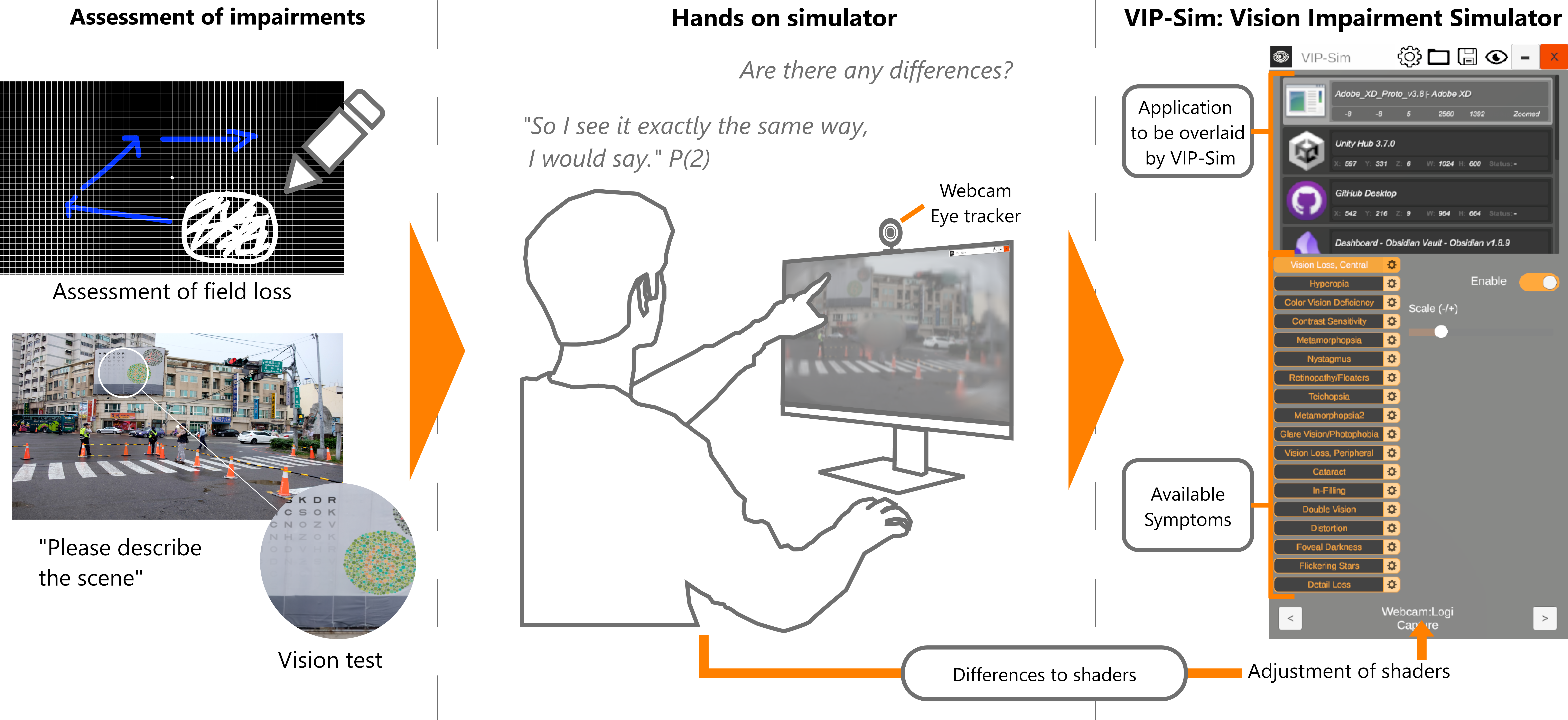
People with vision impairments (VIPs) often rely on their remaining vision when interacting with user interfaces. Simulating visual impairments is an effective tool for designers, fostering awareness of the challenges faced by VIPs. While previous research has introduced various vision impairment simulators, none have yet been developed with the direct involvement of VIPs or thoroughly evaluated from their perspective. To address this gap, we developed VIP-Sim. This symptom-based vision simulator was created through a participatory design process tailored explicitly for this purpose, involving N=7 VIPs. 21 symptoms, like field loss or light sensitivity, can be overlaid on desktop design tools. Most participants felt VIP-Sim could replicate their symptoms. VIP-Sim was received positively, but concerns about exclusion in design and comprehensiveness of the simulation remain, mainly whether it represents the experiences of other VIPs.
Contributions
- VIP-Sim: a user-centered vision impairment simulation tool for accessible design
- Opinions and reflections about the usage of VIP-Sim in design processes by VIPs
Citation
@inproceedings{10.1145/3746059.3747704,
author = {R\"{a}dler, Max and Colley, Mark and Rukzio, Enrico},
title = {VIP-Sim: A User-Centered Approach to Vision Impairment Simulation for Accessible Design},
year = {2025},
isbn = {9798400720376},
publisher = {Association for Computing Machinery},
address = {New York, NY, USA},
url = {https://doi.org/10.1145/3746059.3747704},
doi = {10.1145/3746059.3747704},
booktitle = {Proceedings of the 38th Annual ACM Symposium on User Interface Software and Technology},
articleno = {47},
numpages = {20},
keywords = {visual impairments, design methods, accessibility, vision impairment simulator, participatory design, user-centered design},
location = {
},
series = {UIST '25}
}